
Flower Mound Wood Flooring installs wide plank and pattern wood flooring throughout Flower Mound, TX, with more than 20 years of wood flooring experience behind the work. These are the floors people ask for after seeing one, and they are also the floors where the installation decides the outcome more completely than the product does.
A wide board and a herringbone block are both harder to install well than a standard straight-lay strip floor, for the same underlying reason: they are less forgiving of a substrate that is not flat. A narrow board bridges a small dip in a slab and nobody notices. A wide plank spans it and rocks, and a pattern block sitting at an angle to its neighbors telegraphs the same deviation as a visible point in the field.
So most of the work on these floors happens before the first plank is fastened. The slab gets measured and corrected to a tighter tolerance than a straight floor would need, the material acclimates properly because wider boards move more, and the layout is set out on paper and on the floor with working lines before anything is committed. Get those right and the floor is spectacular; skip them and the product cannot save it.
What Wide Plank Actually Changes
Plank Width and How a Room Reads
Width changes the character of a room more than species or color does. Fewer seams across the same floor area reads calmer, more contemporary and more expensive, and it lets the grain of each board be seen as a feature rather than as texture. In a smaller room the same width can feel heavy, which is why we lay boards out in the actual space before the order goes in.
Board Length and End Joints
Width gets the attention and length quietly does half the work. Long boards mean fewer end joints, and end joints are what break up the visual run of a floor. Mixed-length bundles need a deliberate stagger plan so joints do not fall into a repeating stair-step pattern, which is one of those defects nobody can name but everybody notices once it is pointed out.
Solid Versus Engineered in Wide Widths
Seasonal movement scales with board width, so a wide solid board moves considerably more across its face than a narrow one. Engineered construction, with its cross-laid core, is what makes genuinely wide planks practical over a slab and in a house that swings between dry winters and humid summers. Solid wide plank is still an option over a wood subfloor with proper acclimation and fastening.
Pattern Floors
Herringbone
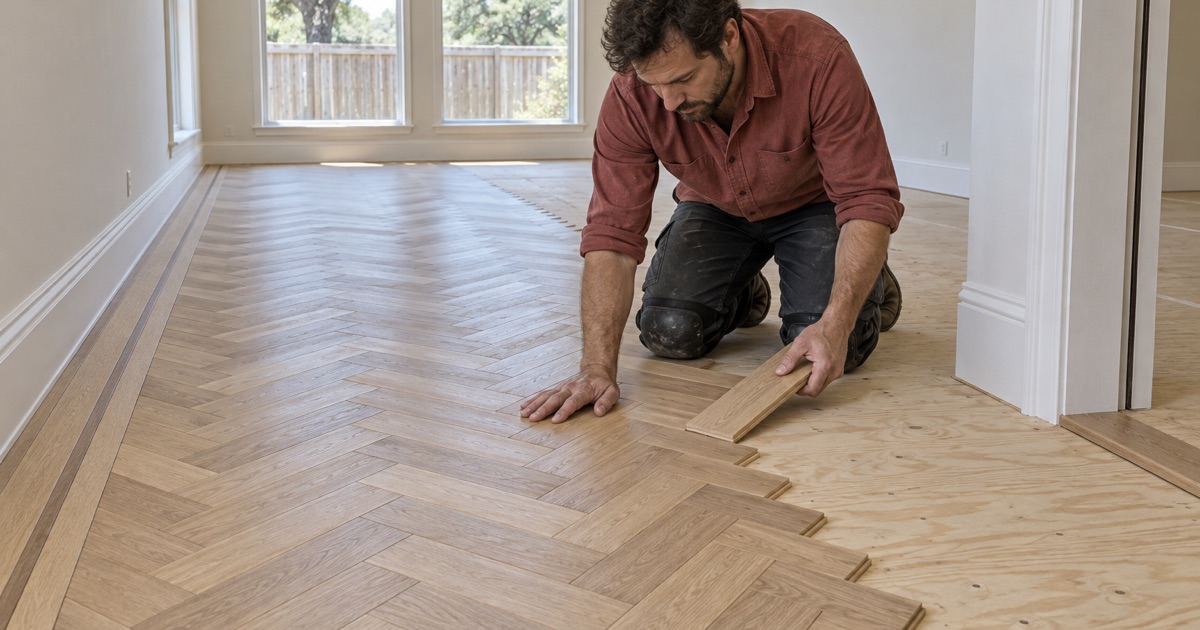
Herringbone lays rectangular blocks at right angles to each other in a continuous broken zigzag, with each block’s end meeting the side of the next. It is the older and more traditional of the two patterns and it works at almost any scale, from a small entry to a full open plan. The entire result depends on the first working line, because every subsequent block references it.
Chevron
Chevron looks similar at a glance and is a different product entirely: the board ends are cut at an angle so that opposing boards meet point to point in a clean, continuous V. Because the angle is milled into the material, chevron blocks are bought as chevron and cannot be improvised from standard planks. The result is sharper and more formal than herringbone.
Borders, Inlays and Feature Areas
A pattern does not have to cover the whole house. A herringbone entry inside a border, a chevron feature in a dining area, or a simple contrasting border framing a straight-lay field are all ways to get the effect where it is seen without the cost across every room. Each needs its transition and border detail designed before installation, not improvised at the boundary.
Installing Wide and Patterned Floors
Substrate Flatness Gets Stricter
Every flooring manufacturer publishes a flatness tolerance, and wide and patterned floors are where exceeding it becomes visible fastest. We map the slab with a long straightedge, bring high spots down with concrete grinding and fill lows with self-leveling underlayment, then re-measure before releasing the floor for installation rather than trusting the original reading.
Fastening and Adhesive for Wide Boards
A wider board has more surface area trying to move, so it needs more holding force. Over a slab that usually means a full-spread adhesive rather than a spot application, and over a wood subfloor it means correct fastener spacing and crown width so the tongue is not crushed. Manufacturer instructions on wide-width products are frequently stricter than for standard plank, and we follow the ones for the product being installed.
Layout, Working Lines and Waste
Pattern work begins with a center line and a set of squared working lines snapped on the substrate, and everything after that is built off them. An error of a fraction at the center becomes an obvious wedge at the far wall. We also plan for higher waste on pattern jobs, because the cuts at every wall and obstruction consume material a straight lay would not.
Species, Texture and Finish
White Oak and Character Grades
White oak dominates the wide plank market, because it takes light and neutral finishes cleanly and its grain looks right at scale. Grade matters as much as species: a select grade gives a uniform, quiet floor, while a character grade brings knots, mineral streaks and color variation that suit a rustic or European look. Wide boards show whichever you choose very clearly.
Wire-Brushed and Hand-Scraped Textures
Texture on a wide plank does more than it does on a narrow board, because there is more of each board to see. Wire-brushing scrubs out the soft grain and leaves the hard grain proud, which hides daily wear well and gives depth under a matte finish. Hand-scraping reads rustic and sculpted. Smooth is crisp and shows every mark on a large surface.
Sheen and Living With Seasonal Movement
Matte and low-satin sheens suit these floors best, both because they read modern and because they disguise the shadow line a wide board’s seasonal gapping can throw under a bright finish. Keeping indoor humidity reasonably steady through the year does more for a wide plank floor than any product choice, and we go through that with you at handover rather than leaving it unsaid.
- 20+ Years on Wood Floors
- Dustless Sanding and Containment
- Written Scope Before Work Starts