Wood Flooring in Flower Mound, TX

Refinishing, repair and installation of solid and engineered hardwood, with the slab tested for moisture before an install date is ever set.

Flower Mound Wood Flooring has spent more than 20 years working wood floors, the last two decades of them on North Texas slabs here in Flower Mound, TX. We refinish and repair existing hardwood, install solid and engineered floors, level and repair subfloors, rebuild stairs in wood, and put water-damaged floors back together after a slab leak or an appliance failure. Commercial wood flooring in offices, showrooms and retail space is part of the work as well.

Most calls we take are not about a brand-new floor. They are about a floor that is dulling, gapping, cupping or lifting away from the slab, and the first useful thing anyone can tell you is how deep the fix actually needs to go. We price that ladder honestly: if a screen and recoat will buy your floor several more years, we say so instead of selling a full sand you did not need.

Before an installation date goes on a calendar, we test the slab. An ASTM F2170 in-situ relative humidity test in the concrete and a pinless moisture meter on the boards tell us whether the slab is ready, and if it is not, we say so before material is ordered rather than after it is stacked in your living room. Every job starts with a written scope, so the price is agreed at the beginning instead of discovered halfway through.

Get Your Free Quote

Fast response • No obligation

So we can reach you about your request.

So we can send you a confirmation after you submit this inquiry form.

  • 20+ Years on Wood Floors
  • Dustless Sanding and Containment
  • Written Scope Before Work Starts

What we do

Our Services

Hardwood Floor Refinishing and Installation in Flower Mound, TX

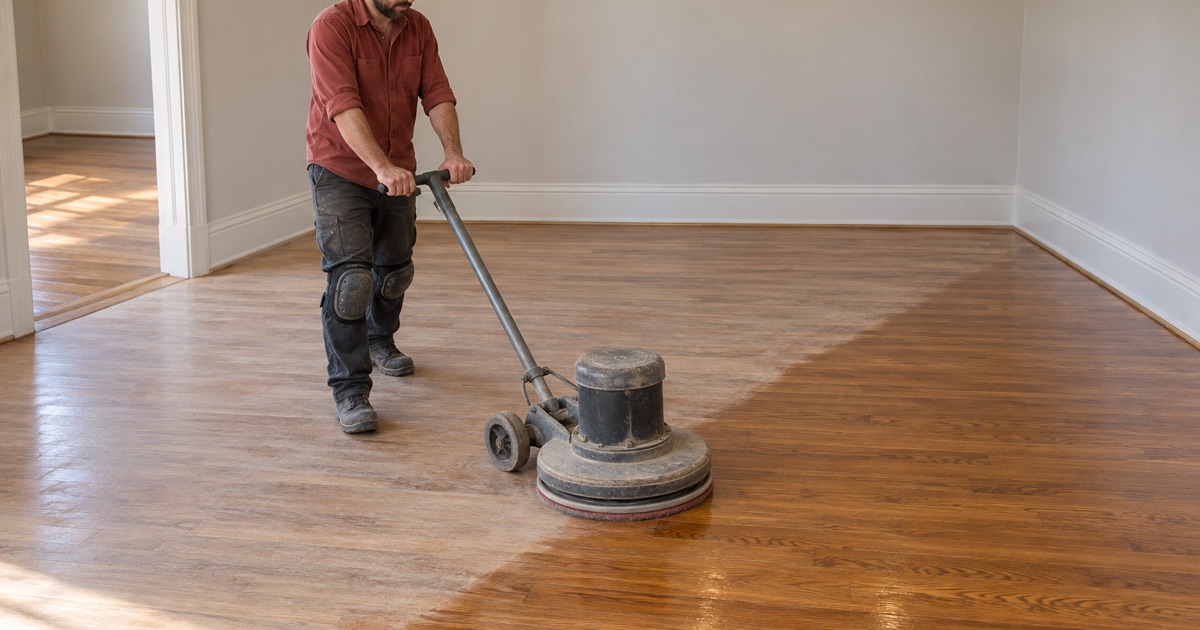
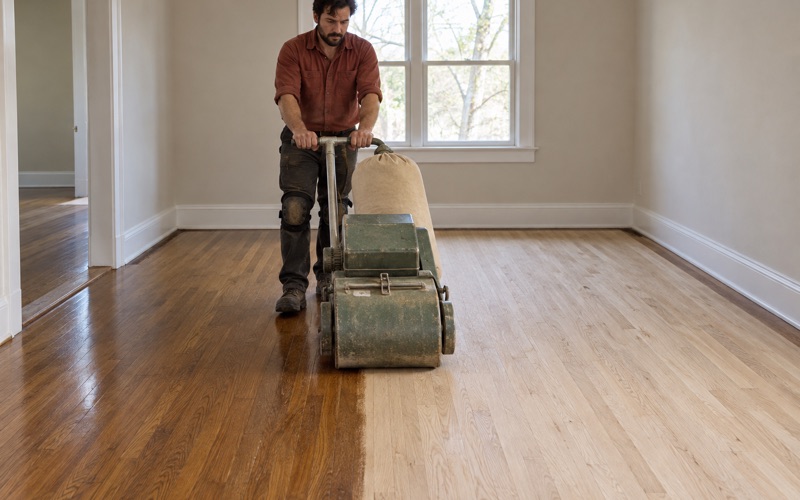
Operator walking a drum sander back across a white oak floor in a Flower Mound house, bare pale wood behind the machine and old finish ahead of it.

Hardwood Floor Refinishing

Dust-contained sanding, screen and recoat, stain changes and finish work on hardwood floors in Flower Mound, TX, with the depth measured before it is quoted.

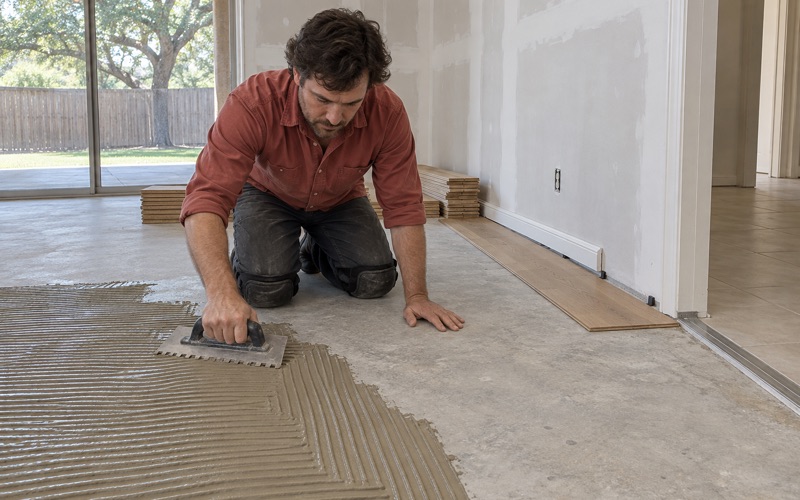
Installer spreading adhesive with a notched trowel across a Flower Mound slab, engineered oak planks stacked flat beside him ready to bed in.

Engineered Hardwood Flooring

Engineered hardwood installed glue-down or floating over concrete slabs in Flower Mound, TX, with wear layer and core specified before you buy.

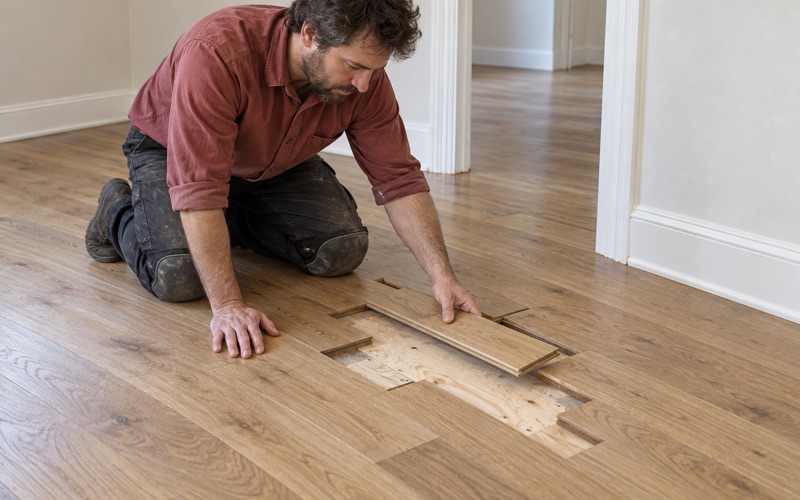
Carpenter setting a dutchman patch into a white oak floor in a Flower Mound house, its joints staggered into the surrounding boards.

Hardwood Floor Repair

Board replacement, weave-in repairs, squeak and hollow-spot fixes and water damage repair for hardwood floors in Flower Mound, TX.

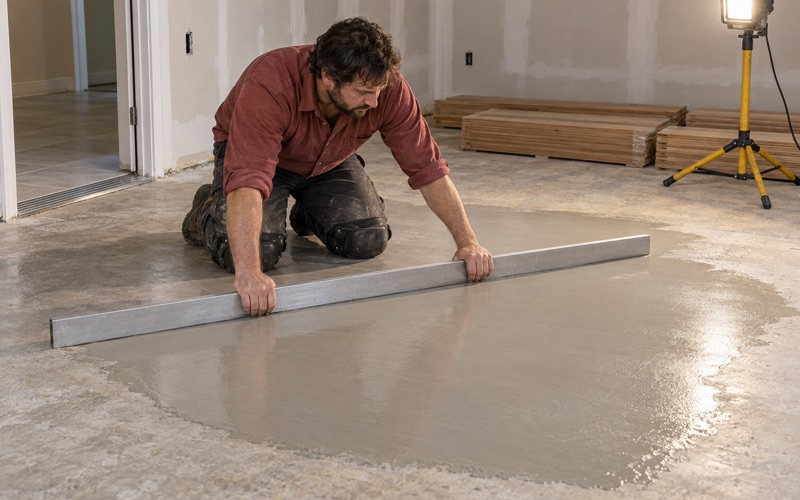
Technician sweeping a long straightedge across a Flower Mound slab after foundation work, leveling compound feathering out where the concrete falls away.

Subfloor Repair And Floor Leveling

Concrete grinding, self-leveling underlayment and wood subfloor repair in Flower Mound, TX, measured to the flooring manufacturer's own flatness tolerance.

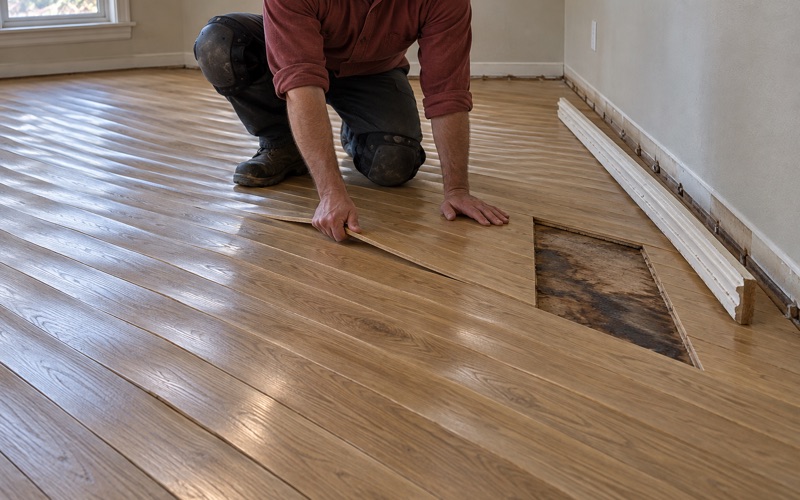
Restorer examining a cupped white oak floor in a Flower Mound house, the boards around him arched at the edges and three lifted out to the subfloor.

Water Damaged Hardwood Floor Repair

Drying, board replacement and refinishing after slab leaks and appliance failures in Flower Mound, TX, documented with dated photos and moisture readings.

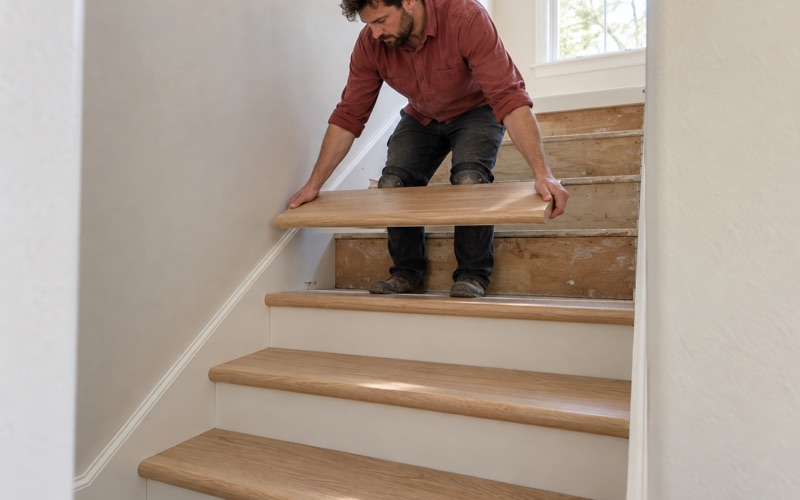
Finisher setting a bullnosed retro tread onto a Flower Mound staircase, its nosing overhanging the riser and the skirt board running up the wall behind.

Hardwood Stairs

Carpet-to-hardwood stair conversion, tread and riser replacement and hand refinishing in Flower Mound, TX, matched to the floor at the bottom.

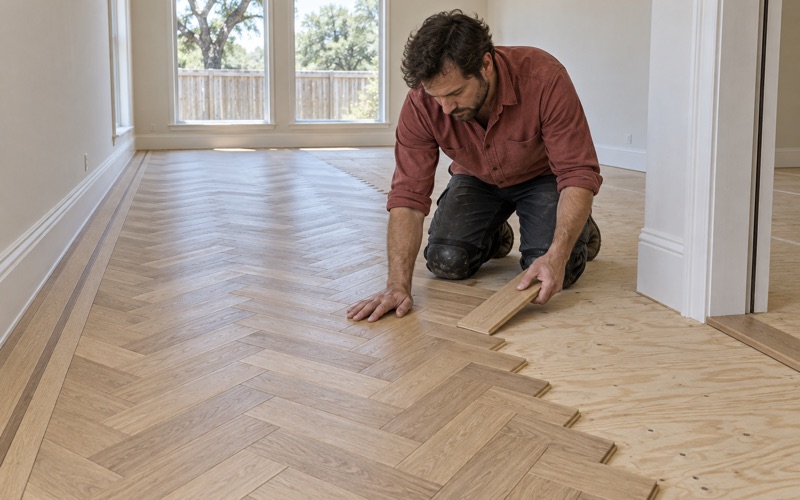
Installer setting a white oak herringbone piece against the working line in a Flower Mound room, the finished field running away behind him.

Wide Plank And Pattern Wood Flooring

Wide plank floors, herringbone and chevron patterns installed in Flower Mound, TX, with the substrate leveled to the tighter tolerance these floors need.

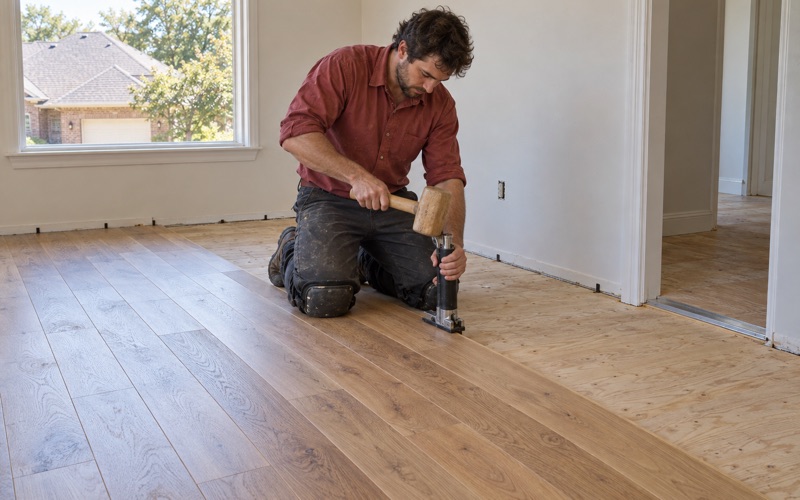
Installer driving a cleat through a white oak board with a flooring nailer and mallet in a Flower Mound house, the run advancing across the plywood subfloor.

Solid Hardwood Flooring Installation

Nail-down solid hardwood installation in Flower Mound, TX, over wood subfloors checked for flatness and moisture before the first row goes down.

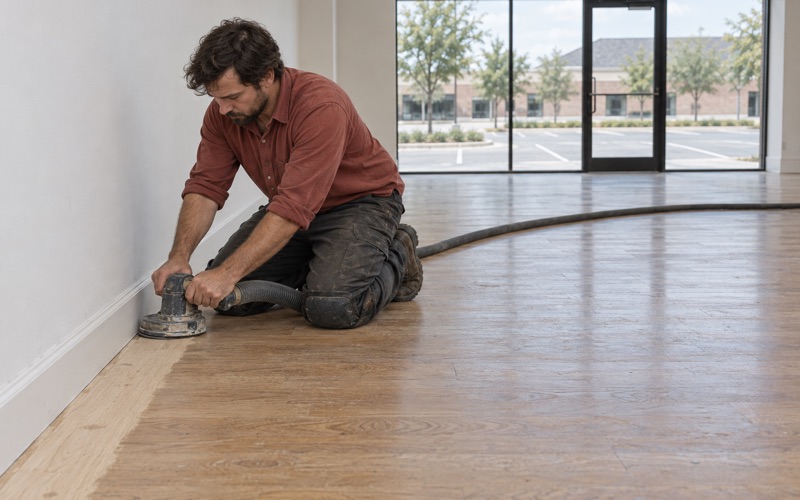
Operator running an edger along the base of an empty Flower Mound tenant suite, the white oak floor cut back to bare wood at the wall.

Commercial Wood Flooring

Wood floor installation, refinishing and recoat programs for offices, retail and hospitality space in Flower Mound, TX, scheduled around your hours.

Two Decades of Wood Floor Work

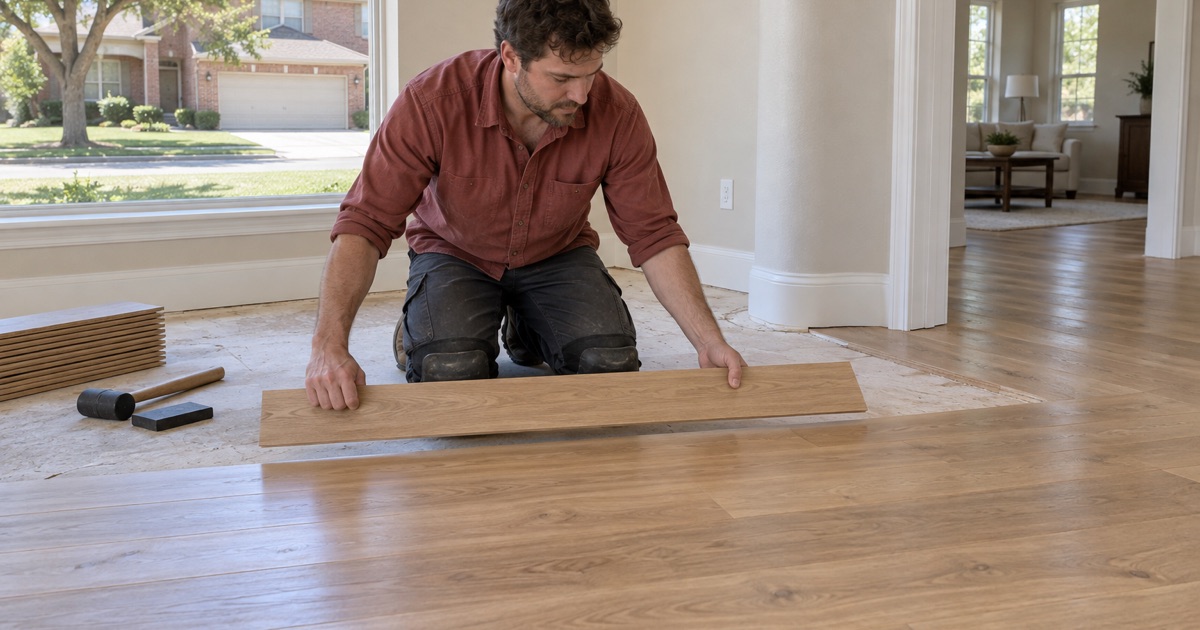
Installer lowering a white oak board beside the previous row in a Flower Mound living room, the laid boards running under the shoe molding behind him.

20+ Years on Hardwood Floors

We have worked wood floors for more than 20 years, and the last two decades of that on slab-on-grade houses in North Texas rather than somewhere with basements and a different moisture problem. That matters more than the raw number: the failures we have learned to head off are the ones this region actually produces, and the sequencing habits behind them came from repeating the same jobs on the same kind of house for a very long time.

Why Choose Flower Mound Wood Flooring

Slab Tested Before Scheduling

Every install date here is set after the slab passes a moisture test, never before. We run an ASTM F2170 in-situ relative humidity probe and confirm it with a pinless moisture meter on the wood, so nothing is fastened over concrete still giving up water rather than discovering it months later when the boards cup.

Repair Depth Priced Honestly

No floor gets taken to bare wood because that is the bigger invoice. We measure what is left of the wear layer first and quote a screen and recoat wherever a screen and recoat is the right answer, so you buy the depth your floor needs rather than a full grit sequence recommended by reflex.

Cross Timbers Soil, Not Blackland Clay

Flower Mound sits in the Eastern Cross Timbers on sandy and sandy-loam soils rather than the deep black clay further east, and Denton County soils mapping shows fine sandy loam through town. We treat foundation movement as a per-lot question the way the Town does when it requires an engineer’s lot-specific soils letter, rather than assuming one regional clay story.

Built to the Code Your Town Adopted

The Town of Flower Mound adopted the 2024 International Residential Code for residential work effective October 1, 2025, while most of the houses here were permitted under a 1990s or 2000s cycle. We work to the edition your jurisdiction has actually adopted, so a subfloor or stair detail meets the right rule rather than a generic national assumption.

One Crew, House Sealed Off

Never is the sanding handed to a subcontractor partway through a job. The crew that starts your floor finishes it, working behind zippered containment with dust extraction tied to the drum sander, edger and buffer, so the rest of the house stays livable rather than coated in a week of fine wood dust.

Putting In a New Floor

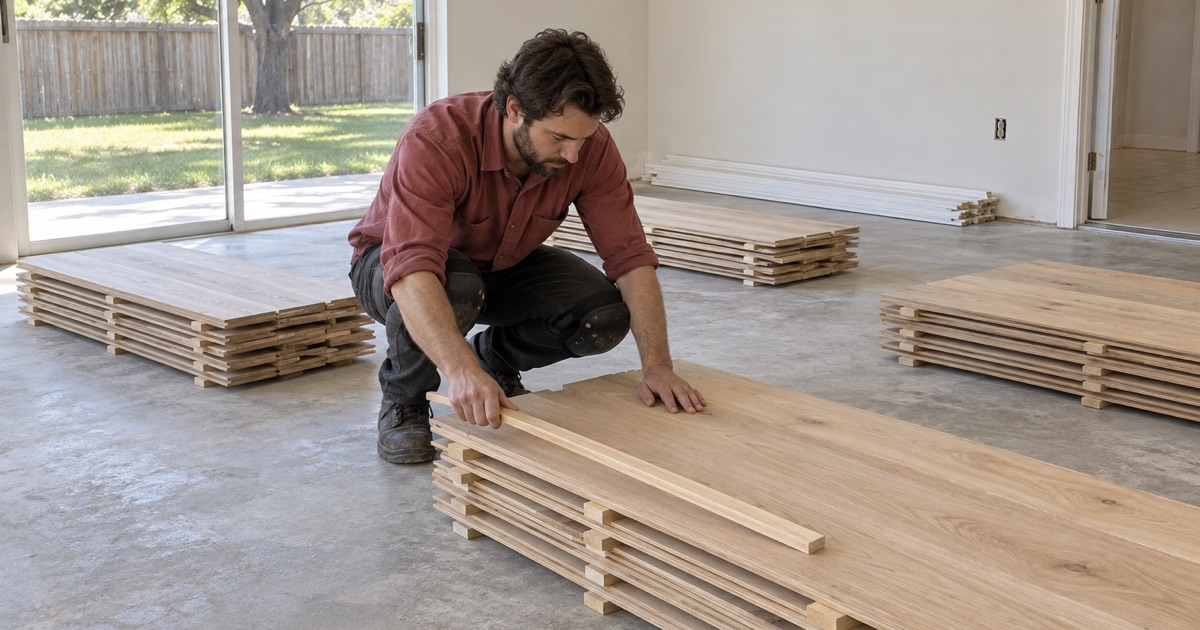
Installer laying a spacer batten across a stack of white oak boards acclimating inside a Flower Mound house before any board is fastened down.

Engineered Hardwood Over a Concrete Slab

Engineered hardwood puts a real wood wear layer over a dimensionally stable core, which is why it is the usual answer on a slab-on-grade house. Over concrete we install it glue-down or floating with an appropriate vapor retarder, and we pick the wear layer thickness by whether you want the floor to be sandable later or replaceable only.

Nail-Down Solid Hardwood Over a Plywood Subfloor

Solid hardwood is one piece of wood through its full thickness, fastened into a wood subfloor with flooring cleats or flooring staples. We check subfloor flatness tolerance and fastener crown width before the first row goes down, because a nailer set too hard crushes the tongue and a subfloor out of tolerance telegraphs every dip through the finished floor.

Slab Moisture Testing Before the Install Date

An in-situ relative humidity test reads the concrete’s internal moisture through probes set into the slab, which predicts far better than any surface reading, while a calcium chloride test measures vapor coming off the surface. We run the test before the date is committed and record the numbers in your scope, because skipping it is how a correctly installed floor still cups within a year.

Glue-Down, Floating and Nail-Down Compared

Glue-down bonds each plank to the slab and feels the most solid underfoot; floating locks boards to one another over an underlayment and moves as a single field; nail-down fastens into wood and is limited to wood subfloors. We match the method to the substrate and to the product’s own installation instructions, since manufacturers void warranties over the wrong one.

Concrete Grinding and Self-Leveling Underlayment

Wood flooring has a flatness tolerance and most slabs do not meet it as poured. High spots come down with concrete grinding, low spots come up with self-leveling underlayment, and both happen before a single board arrives. Skipping that step is what produces hollow-sounding sections, telegraphed dips and clicking joints on an otherwise correctly installed floor.

Acclimating Boards Inside Your House

Wood moves with the moisture content of the air around it, so boards are brought into the actual house and left to reach equilibrium before anything is fastened down. Acclimation in a garage, on a covered porch or in a truck is not acclimation. We stage material in the rooms it will live in, at the conditions the house normally runs.

Expansion Gaps at Walls and Obstructions

A wood floor has to grow and shrink, so we leave an expansion gap at every wall, cabinet toe kick, column, hearth and door jamb, sized to the product and to the size of the field. Baseboard and quarter round hide it while the gap does the work. A floor laid tight to the walls has nowhere to go, which is how tenting starts.

Hardwood Stair Treads, Risers and Carpet Conversion

Stairs are their own trade inside flooring: stair treads, risers, stair nosing and return details are cut and fitted one at a time. Converting a carpeted stair means stripping it, assessing the stringers and rough treads underneath, then building the finished assembly on top. We run stairs in the same species and sheen as the floor so the flight reads as one surface.

T-Molding, Reducers and Room Transitions

Where wood meets tile, carpet or a different floor height, a transition carries the change: T-molding between equal heights, a reducer down to something thinner, a threshold in a doorway. We plan these with the field layout instead of improvising at the end, because a transition in the wrong plane turns a doorway into a trip point.

Restoring the Floor You Have

Operator running a buffer across a red oak floor during a screen and recoat in a Flower Mound house, the sheen breaking evenly ahead of the machine.

Full Sand and Refinish Versus Screen and Recoat

A full sand takes the floor to bare wood through a grit sequence with a drum sander, an edger around the perimeter and a buffer to blend, and it is the only route that removes deep scratches, staining and old color. A screen and recoat abrades the finish only and lays fresh coats on top. They are different jobs at very different prices.

Dustless Sanding and Whole-House Containment

Our sanding equipment runs on a dust containment system, and the work area is sealed off from the rest of the house before the first pass. Furniture goes out and comes back, and the space is left clean at the end of each day. Airborne dust settles into wet finish as readily as into your air return, so controlling it protects the floor too.

How Many Sandings a Floor Has Left

Solid hardwood can generally be sanded several times over its life, while engineered hardwood can be sanded as many times as its wear layer thickness allows, which may be twice, once or not at all. We measure at a vent, a threshold or a lifted board rather than guessing, because a floor with one sanding left is one to recoat and protect.

Waterborne Versus Oil-Modified Polyurethane

Waterborne polyurethane dries fast, stays clear and puts far less odor into the house, so a room comes back into service sooner. Oil-modified polyurethane ambers with age, which some homeowners want on red oak, and it takes longer between coats. Hardwax oil penetrates instead of forming a film and spot-repairs well. We match the finish to how the room is used.

Changing Stain Color on an Existing Floor

Changing color means a full sand, because stain lives in the wood rather than on top of the finish. Species sets what is achievable: red oak carries pink undertones that fight a cool gray, while white oak takes light and dark tones cleanly. We lay sample boards down in your own light before committing the whole floor.

Refinishing Stairs Alongside the Floor

Stairs are refinished by hand and take longer per square foot than anything else in the house, which is why some quotes quietly leave them out. We price them in, sand the treads, risers and nosings, and match the sheen level to the floor. A hallway in fresh satin beside an untouched amber staircase is a mismatch you see from the front door.

Blending a Repair Into an Existing Finish

A weave-in repair or dutchman patch laces new boards into the existing field so the seam disappears instead of reading as a rectangle. Board replacement is only half the job; the patch then has to be sanded and finished into the surrounding floor, which usually puts the whole room in scope. We say which rooms those are before we start.

Recoating Before the Wear Layer Is Gone

Once traffic lanes wear through the finish into bare wood, a full sand is the only option left. Caught earlier, while the finish is dull but still intact, the same floor takes a screen and recoat at a fraction of the time and cost. If your floor has two more years in it, we will tell you that rather than book a sand.

What Sanding Removes, and What It Cannot

Sanding takes out surface scratches, shallow dents, old finish, most surface staining and the previous color. It does not remove a pet stain that has soaked through into the wood, water staining that reached the subfloor, or a board that has cupped past flat. Those need board replacement first, and we identify them at the walkthrough rather than mid-job.

When Something Has Gone Wrong

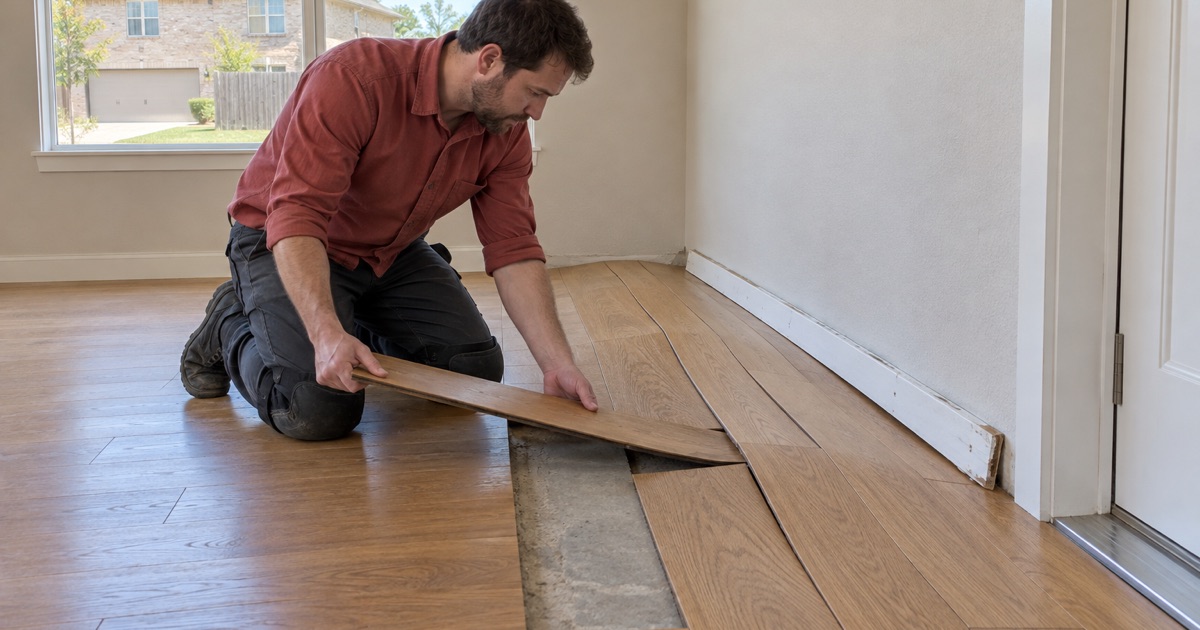
Worker lifting a buckled engineered oak plank clear of a Flower Mound slab, the boards on either side arched up off the concrete along the wall.

Cupping and Crowning: Reading the Board Profile

A cupped board sits higher at its edges than at its center, which means the underside is wetter than the top and usually points at moisture from below. A crowned board is the reverse profile and often means a cupped floor was sanded flat before it dried out. We find and correct the moisture source first, because sanding early guarantees a second failure.

Buckling and Tenting Off the Slab

Buckling is a floor lifting clear of its substrate, and tenting is two boards rising into a peak along one seam. Both mean the field expanded with nowhere to go, whether from a moisture event or from an expansion gap that was never left at the perimeter. We look for the lost gap, the bond failure or the water before any board goes back.

Seasonal Gapping in Winter and Summer

Gaps that open while the heat runs and close again in humid months are the floor breathing, and within limits that is normal wood behavior rather than a defect. Gaps that stay open through a full year, or appear in only one part of a room, are saying something else. We treat persistent seasonal gapping as a moisture or fastening question.

Water Damage From Slab Leaks and Appliance Failures

A supply line under the slab, a dishwasher, an icemaker line or a water heater can put water under a wood floor for days before anyone notices. We document these jobs the way a claim needs: dated photographs, moisture readings recorded as they were taken, and an itemized scope separating what must come out from what can be dried and saved.

Flooring Replacement After Foundation Repair

Foundation work lifts and re-seats a slab, and the wood floor over it moves with the slab, which is why we sequence flooring after the foundation contractor rather than beside them. We wait for the slab to settle into its corrected position, re-check flatness with grinding and self-leveling underlayment where needed, then rebuild over ground that has stopped moving.

Uneven and Sloping Floors Over a Moving Slab

A floor that reads uneven underfoot may be a subfloor problem, a slab problem, or both, and the correct fix is different in each case. We measure the deviation before proposing anything and stay in our lane: leveling and flooring are ours, while structural foundation work belongs to an engineer. Where an engineer’s report exists, we build to it.

Termite and Wood-Rot Damage in Flooring

The code table the Town has adopted designates the termite infestation probability here as Very heavy, which makes what sits under an opened floor genuinely worth inspecting. When we pull damaged boards we check the subfloor and framing beneath for tunneling and rot, replace what has lost structure, and say plainly when a finding belongs to a pest professional.

Pet Stains, Scratches and Dents

Surface scratches and light dents generally sand out. A pet stain does not, because urine penetrates the wood and often the subfloor under it, and no amount of sanding removes what has soaked through. We test the affected boards, replace the ones that will not come clean, and lace the replacements into the field so the repair blends.

Hollow Spots, Loose Boards and Squeaks

A hollow sound underfoot on a glue-down floor is a bond that has released, while a squeak on a nail-down floor is usually movement between the board, the fastener and the subfloor. Both are diagnosed by mapping the boundary of the affected area rather than by chasing one board, and we correct the flatness problem that often caused it.

Choosing the Look

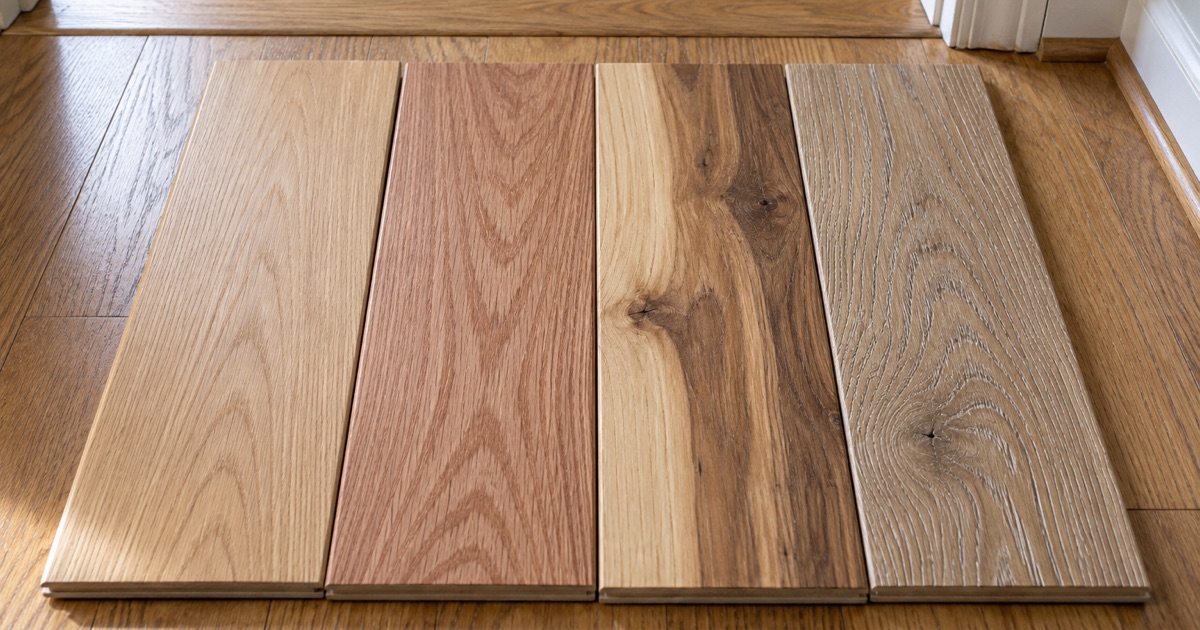
Four wood floor samples laid side by side on a Flower Mound floor — white oak, red oak, hickory and a wire-brushed plank — meeting a reducer at the tile.

White Oak, Red Oak and Hickory Compared

Red oak is the most common domestic hardwood in existing homes and carries warm pink undertones with a strong grain. White oak is slightly harder, reads cool and neutral, and takes the light and gray-toned finishes people ask for now. Hickory is harder still with dramatic variation between boards. Janka hardness rating ranks them, but grain and undertone usually decide it.

Wide Plank Flooring

Wider boards show more of each board’s figure and put fewer seams in a room, which reads calmer and more contemporary. They also move more across their width with seasonal humidity, so plank width changes how the floor is fastened, how much acclimation matters, and how visible seasonal movement will be. We plan for that up front.

Herringbone and Chevron Pattern Floors

Herringbone sets rectangular blocks at right angles into a broken zigzag, while chevron cuts the board ends on an angle so the points meet in a clean V. Both are labor-intensive layouts whose working line has to be set perfectly at the start, since an error at the center is magnified at every wall. We set the pattern out against the room’s sightlines.

Wire-Brushed, Hand-Scraped and Smooth Textures

Wire-brushing scrubs out the soft grain and leaves the harder grain standing proud, which hides daily wear well. Hand-scraped surfaces carry a sculpted, undulating character that reads rustic, while smooth is the crispest and least forgiving of scratches. Texture is worth choosing against how the room is actually lived in, particularly with dogs or a busy back entry.

Matte, Satin and Semi-Gloss Sheen Levels

Sheen level is how much light the finish returns, and it changes the apparent color of an identical stain. Matte hides dust, footprints and fine scratches best and is where most current work lands, satin adds warmth and depth, and semi-gloss is bright and shows everything. We match sheen across floor, stairs and repairs so the run reads as one.

Light, Natural and Dark Stain Colors

Light and natural tones make a room read larger and hide dust between cleanings. Dark stains are dramatic and pull a room inward, but they show dust, pet hair and scratches sooner. Undertone matters as much as depth, since the same stain reads warm on red oak and cool on white oak, so we sample in your own rooms first.

Engineered Versus Solid: What You Can Actually See

Finished and installed, a good engineered hardwood floor and a solid hardwood floor look the same from standing height, because the visible surface of both is real wood. The differences sit underneath: core construction, wear layer thickness, how many refinishes remain, and which substrates each can go over. The decision is about the house, not the look.

Matching New Flooring to Adjoining Rooms

Extending a floor into a new room, or replacing part of one, is a matching problem in three dimensions: species, plank width and finish color, plus the age of the existing floor, which has ambered. Running the new field in the same direction and lacing it in at the doorway avoids a visible break. Where a true match is impossible we say so.

Plank Width, Length and Board Direction

Long boards mean fewer end joints and a calmer floor, while mixed-length bundles need a stagger pattern planned so joints do not stack up. Direction is usually set by the longest sightline, the joist run on a wood subfloor, or the main light source. We walk the layout with you first, because direction cannot be revised once the field is down.

Areas We Serve

Flower Mound Wood Flooring provides wood-flooring throughout the greater Flower Mound area, with the same crews and the same standards on every job.

Good to know

Frequently Asked Questions

How much does hardwood floor refinishing cost in Flower Mound?

Refinishing is priced by square footage, by the condition of the floor and by how deep the work has to go. A screen and recoat costs a fraction of a full sand to bare wood, and stairs are priced separately because they are hand work. We measure the floor, tell you which depth it actually needs, and put the number in a written scope before anything starts.

Should I refinish my floor or replace it?

That depends on how much wood sits above the tongue. Solid hardwood usually has several sandings left in it and is worth refinishing well past the point most homeowners assume, while engineered hardwood depends entirely on its wear layer thickness and some products cannot be sanded at all. We measure at a vent or a threshold and give you the honest answer.

How long does a hardwood floor job take?

A screen and recoat on an average room is usually finished within a couple of days including cure time. A full sand and refinish takes longer because of the grit sequence, a stain step if you are changing color, and the coats on top of it. Installations add slab preparation and acclimation before the first board. Your written scope carries the schedule.

Do I have to move out while you work?

Most homeowners stay. We seal the work area off from the rest of the house, run dust containment on the sanding equipment, and leave the space clean at the end of each day. Finish choice matters here: waterborne polyurethane has far less odor and a faster return to service than oil-modified polyurethane, so we discuss that when the schedule is tight.

Are flooring contractors licensed in Texas?

Texas does not issue a state license for flooring contractors, so anyone offering a state flooring license number is describing something that does not exist. What does exist locally is registration: the Town of Flower Mound requires contractors to register annually as a condition of applying for a permit, under a local amendment to the building code.

Can you install wood flooring over a concrete slab?

Yes, and it is the normal situation here, since nearly all of the housing stock in this area is slab-on-grade. Engineered hardwood is the usual choice over concrete, installed glue-down or floating with a vapor retarder. We test the slab with an in-situ relative humidity probe first, because concrete that is still releasing moisture will fail a floor however well it was laid.

What is the difference between engineered and solid hardwood?

Solid hardwood is one piece of wood through its full thickness and is fastened into a wood subfloor. Engineered hardwood bonds a real wood wear layer to a stable core, which lets it go over concrete and handle moisture swings better. Both look the same once finished, so the choice is driven by substrate, moisture and how many future refinishes you want.

My floor is cupping. Is that fixable?

Usually, but not by sanding it first. Cupping means the underside of the boards is wetter than the top, so the priority is finding the moisture source, whether a slab leak, an appliance, indoor humidity or a missing vapor retarder. Once the cause is corrected and the floor has dried flat, we sand and refinish. Flattening a wet floor produces crowned boards later.

Do you handle water damage documentation for an insurance claim?

We document water damage jobs the way a claim needs them documented: dated photographs of the affected area, moisture readings recorded as they were taken, and an itemized scope separating what has to be removed from what can be dried and saved. We are not adjusters and we do not negotiate your claim, but that record makes the conversation shorter.

Ready to Get Started?

Request a free quote today and we'll get back to you fast.