
Flower Mound Wood Flooring builds and refinishes hardwood stairs in Flower Mound, TX and serving surrounding cities including Lantana, Highland Village, Trophy Club, Southlake and Roanoke, with more than 20 years of wood flooring work behind us. Stairs are the part of the job most flooring companies would rather leave off the quote, and they are the part a visitor sees first.
There is a practical reason so many quotes go quiet on stairs. A floor is installed by area with machines and a predictable rhythm; a staircase is built one step at a time by hand, with every tread cut, scribed and fitted individually, and every riser and return detailed to sit tight against finished walls. It is slower per square foot than anything else in the house, which is why it is priced by the flight or by the step and why it gets skipped.
It is also why finishing the floor and leaving the staircase alone is such a visible mistake. A hallway in fresh matte white oak running up to a worn, ambered staircase does not read as two projects; it reads as one unfinished project. We price stairs into the conversation from the start, and we match them to the floor in species, color and sheen so the whole run is one surface.
The Anatomy of a Hardwood Stair
Treads and How They Are Fitted
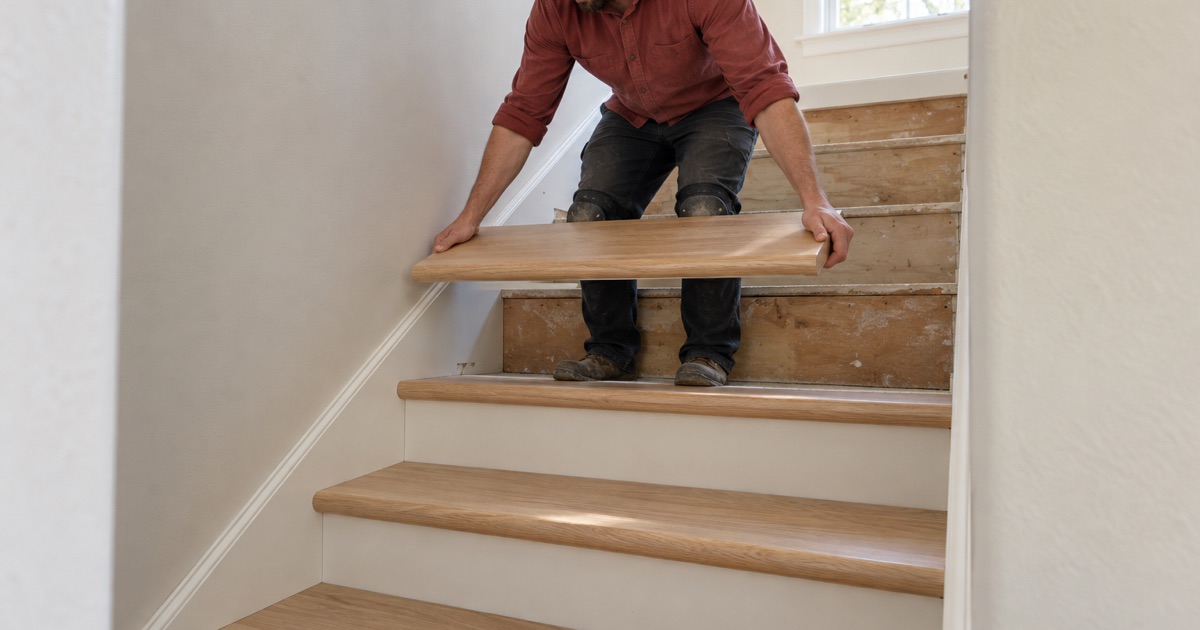
A stair tread is the horizontal surface you step on, and unlike a floor board it has to be fitted on all four edges: scribed to the skirt board or wall on each side, tight to the riser behind it, and finished with a nosing at the front. Treads take the entire load and wear of the staircase, so they are cut from thicker stock than floor boards and fastened accordingly.
Risers and the Vertical Face
The riser is the vertical board between one tread and the next, and it does more visual work than people expect. Painted white risers against stained treads is the most requested combination we install, though matching stained risers give a heavier, more traditional look. Risers also close off the stair structurally, which matters for how the flight sounds and feels underfoot.
Stair Nosing, Returns and Skirt Boards
The nosing is the rounded or squared front edge that overhangs the riser below, and it is what makes a stair read as finished rather than assembled. On an open side, the tread gets a mitered return so no end grain shows. The skirt board runs the slope of the flight along the wall and every tread has to be scribed into it. These details are most of the labor and all of the difference.
Converting a Carpeted Staircase to Hardwood
What Is Actually Under the Carpet
Almost never a finished hardwood stair. Builders carpeting a flight have no reason to finish wood nobody will see, so what comes off the tack strips is usually rough treads, open or unfinished risers, staples, adhesive and construction pencil marks. We pull back a corner of the carpet during the estimate so the quote is based on what is really there instead of on an optimistic assumption.
Full Replacement Versus Retread Systems
There are two routes. Full replacement removes the rough treads and risers and installs new solid stock, which is the cleanest result and the right answer when the existing stock is damaged or the heights need correcting. A retread system caps the existing structure with new treads and riser covers, which is faster and less invasive where the underlying framing is sound and consistent.
Matching the Stair to the Floor Below
A conversion is not finished when the treads are down. The stair has to match the floor at the bottom in species, plank character, stain color and sheen level, and on a site-finished job the best way to guarantee that is to sand and finish both together. Where the floor is prefinished, we source matching stair parts and check them against the real floor in the room’s own light.
Refinishing Existing Wood Stairs
Hand Sanding and Detail Work
A staircase cannot be sanded with the equipment that does a floor. Treads are worked with smaller sanders, and the nosings, returns, skirt boards and the tight angles where tread meets riser are done by hand. That is why stair refinishing takes the time it does, and why a contractor who quotes stairs at the same rate as floor area has not thought about the job.
Balusters, Newels and Skirt Boards
A refinish has to account for everything the treads touch. Balusters can often stay in place with careful masking, or they can come out and go back if they are being refinished or replaced at the same time. Newel posts, handrails and skirt boards each take their own preparation, and we agree in the scope which of them are included rather than leaving it ambiguous.
Sheen, Wear and How Stairs Age
Stairs wear differently from floors, concentrated on the leading edge of each nosing where every foot lands. That means the sheen that looks right in a hallway may show wear faster on a stair, and it means the nosings often need more attention during sanding than the tread field does. We finish stairs to the same sheen as the floor while accounting for that wear pattern in the preparation.
Fit, Safety and the Details That Get Missed
Consistent Riser Heights
People climb stairs by muscle memory, so a flight where one riser differs noticeably from the rest is a genuine trip hazard, and consistency within a flight is a building code requirement rather than a preference. Builder-grade framing under carpet is frequently less consistent than it looks. We measure every riser during the estimate and tell you what correcting it involves.
Working to the Adopted Code
Flower Mound adopted the 2024 International Residential Code for residential work effective October 1, 2025, and neighboring jurisdictions in this area are on their own editions and their own adoption dates. We build to the edition the jurisdiction where your house sits has actually adopted, rather than to a generic national assumption, and we say up front when a detail is governed by that rather than by preference.
Landings, Transitions and Where the Stair Meets the Floor
The top and bottom of a flight are where a stair job either resolves cleanly or does not. A landing has to be treated as its own small floor with its own nosing detail, and the bottom step often needs a return or a bullnose that ties into the finished floor. We plan those transitions with the floor layout rather than solving them after the field is down.
Our Step-by-Step Hardwood Stairs Process
Step 1: Estimate With the Carpet Pulled Back
We lift a corner of the carpet, look at the actual substrate, measure every riser and tread, check the skirt and baluster condition, and count the steps and returns. The quote comes from those measurements, itemized by flight, so nothing about the stair is a guess added to a floor price.
Step 2: Demolition, Assessment and Correction
Carpet, pad, tack strip and staples come out, the framing gets inspected, and any inconsistency in riser height or damage to the stringers is identified before new material is cut. Where a correction belongs to a carpenter or an engineer, we say so at this point rather than covering it with a thicker tread.
Step 3: Fitting Treads, Risers and Returns
Each tread is cut, scribed to the skirt and dry-fitted before it is fastened, and risers and mitered returns are fitted as the flight is built from the bottom up. This is the slow part and it is the part that decides whether the stair looks built or looks bolted on.
Step 4: Sanding, Finishing and Handover
The flight is hand sanded, stained to match the floor where staining is involved, and coated to the same sheen with the cure time each coat needs. We stage the work so the household keeps access to the upper floor wherever the layout allows, and hand back a clean stair with the cure schedule in writing.
- 20+ Years on Wood Floors
- Dustless Sanding and Containment
- Written Scope Before Work Starts